
Form E in Divorce: Financial Disclosure Explained
If you are getting divorced and need to reach an agreement about your finances, you may have been told that you need to complete a Form E.
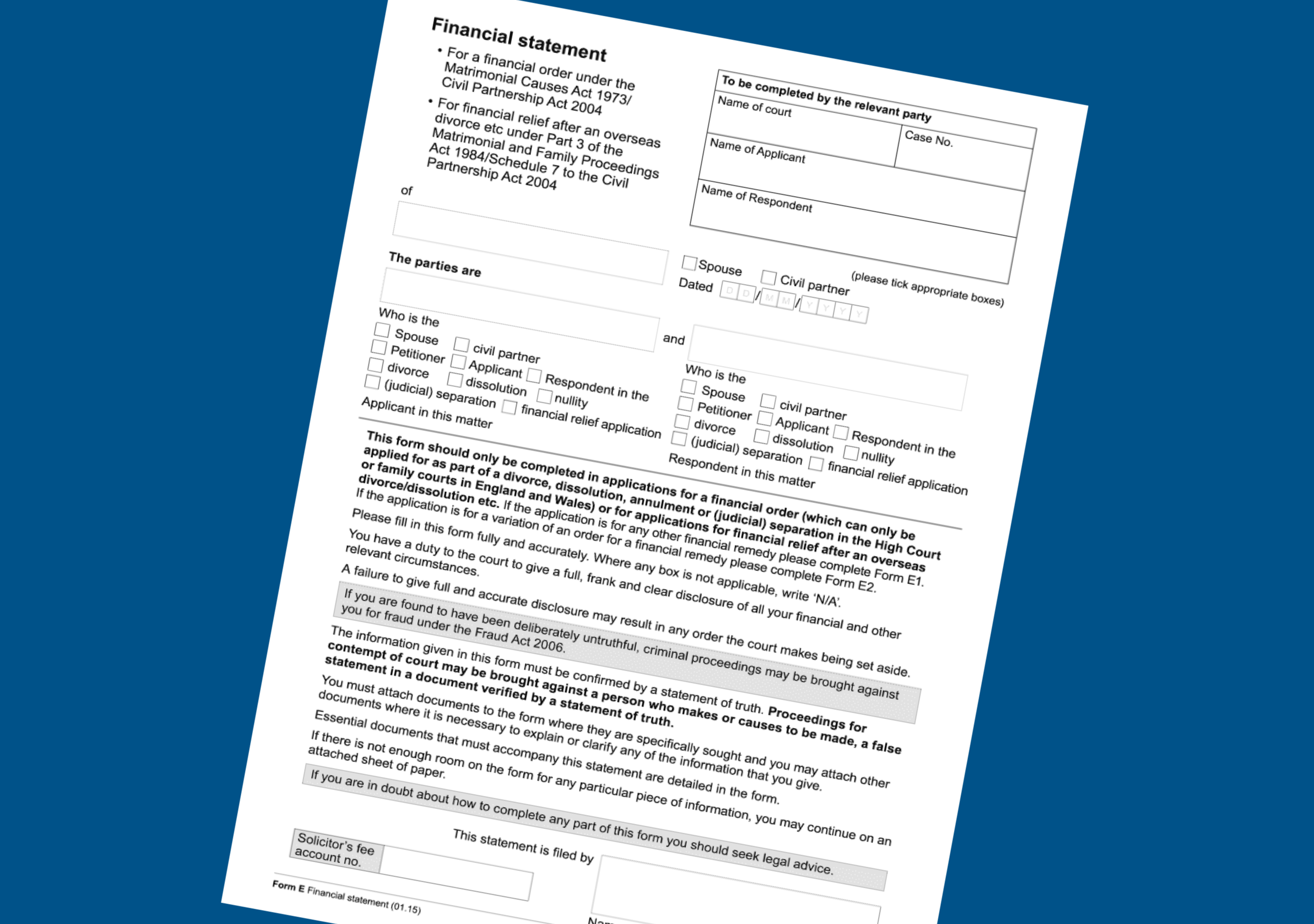
A Form E is a detailed financial statement used to provide financial disclosure during divorce or the dissolution of a civil partnership. It includes information about your property, bank accounts, savings, investments, pensions, business interests, income, debts and future financial needs. You will also need to provide documents to support much of the information you give.
At first glance, Form E can feel daunting. There are a lot of questions to answer, documents to gather and financial details to think about. But there is a good reason for the level of detail involved. Before you and your former partner can make properly informed decisions about a financial settlement, you both need to understand each other's financial circumstances. Form E provides a structured way of establishing that picture.
Our Family Law solicitors help people prepare their financial disclosure, understand the information their former partner has provided and deal with questions or concerns that arise along the way.

Our free guide to Form E and financial disclosure
If you've been asked to complete Form E, you might be wondering where to start, what information you need or whether you're going to miss something important.
We've put together a comprehensive guide to help you understand the process.
It explains what Form E is asking for, which documents you'll need and how to approach the different sections. It also looks at what happens after Forms E are exchanged, how questions about missing information are dealt with and why businesses, pensions and other complicated assets sometimes need particular attention.
Whether you're preparing your own Form E or trying to understand the information your former partner has provided, it's a useful resource to have alongside you.


What is a Form E?
A Form E is a financial statement used to provide detailed financial information when financial matters need to be resolved during divorce or the dissolution of a civil partnership.
Both you and your former partner will need to provide information about your respective financial circumstances, supported by relevant documents, where Forms E are required.
If financial remedy proceedings have been started at court under the standard procedure, Forms E are an important part of the financial disclosure process. Both parties will normally be required to complete and exchange their Forms E before the First Appointment.
Forms E can also be used when court proceedings haven't been started and you are trying to resolve financial matters by agreement.
They provide an established framework for exchanging financial information before negotiations, mediation or another form of non-court dispute resolution.
Completing Form E doesn't necessarily mean that your divorce finances will need to be resolved in court.
Why is financial disclosure important in divorce?
Before you can reach an informed agreement about your finances, you need to understand what the full financial picture looks like.
Financial circumstances are often more complicated than they first appear.
There may be property, savings, mortgages, loans, investments and several pensions. One person may own a business or company shares. Income might include bonuses, dividends or investment income as well as a salary. There may also be inherited assets or property owned before the marriage.
All this information may need to be disclosed so that proper advice can be given about a possible financial settlement.
It's important to understand the difference between financial disclosure and financial entitlement.
If you disclose an asset, you are not agreeing that your former partner is entitled to half of it.
For example, you may have inherited £200,000, owned a property before your marriage or established a business many years before meeting your spouse.
Those circumstances may be relevant when deciding how that particular asset should ultimately be treated.
But the first stage is establishing the financial picture.
The second is taking legal advice about how those finances should appropriately be dealt with.


When do you need to complete Form E?
There are two main circumstances in which you may encounter Form E.
Form E during financial remedy proceedings
If an application has been made to the court to resolve financial arrangements under the standard financial remedy procedure, both parties will normally be required to complete a Form E.
You each provide your own financial information and supporting documents and exchange your Forms E so that both sides understand the other's financial position.
A Form E is verified by a Statement of Truth, so the information you provide needs to be accurate and complete.
Voluntary Form E
Forms E are also commonly used to exchange financial information when court proceedings haven't been started.
You may be trying to reach an agreement through discussions between solicitors, mediation, collaborative law or another form of non-court dispute resolution.
Using Forms E gives both parties a recognised structure for providing information.
Voluntary financial disclosure at an early stage of negotiations can make reaching an agreement much easier because both people have a clearer picture of the finances.
What information do you have to provide on Form E?
Form E asks for considerably more than the value of your home and the amount you have in your bank account.
You will need to provide information about various aspects of your finances.
Property
You will need to disclose your interest in the family home and other relevant property or land.
This may include second homes, buy-to-let properties, holiday homes, commercial property, land and property overseas.
Information may be required about ownership, current value and mortgages or other borrowing secured against the property. You will also need to provide appropriate evidence to support the information you've given.
Bank accounts and savings
You will need to provide details of relevant bank, building society and savings accounts, including joint accounts.
Form E requires statements covering the relevant period, normally including 12 months of statements for bank and building society accounts.
Don't assume an account can be left out because there's very little money in it or because you rarely use it. Relevant accounts must be disclosed regardless of the amount they contain.
Investments
Shares, ISAs, investment portfolios and other relevant investments will need to be disclosed.
Where investments fluctuate in value, updated information may eventually be required before a settlement is finalised.
Businesses and company shareholdings
If you own a business, are a partner or hold shares in a private company, this can be one of the more complicated areas of financial disclosure.
The amount of money held by a company isn't necessarily the value of your interest in it.
Equally, a director's salary may not provide a complete picture where they also receive dividends or other benefits.
Depending on the significance and complexity of the business, further financial information or an independent business valuation may eventually be required.
Pensions
All relevant pensions should be identified, not simply your current workplace pension.
This may include pensions from previous employers, personal pensions, defined benefit or final salary arrangements, public sector pensions and Armed Forces pensions.
A Cash Equivalent Value can provide important information about a pension. However, pensions with apparently similar values don't necessarily provide equivalent retirement benefits.
More complicated or substantial pension arrangements may require specialist advice.
Income
You will need to provide information about your income.
For an employee, this may include salary, bonuses, commission and other remuneration. Business owners may receive salary and dividends. Someone who has retired might receive income from several pensions and investments.
The objective is to provide an accurate picture of your financial resources rather than simply quoting your basic salary.
Debts and liabilities
Relevant loans, credit cards, tax liabilities and other debts also form part of the financial picture.
Where money is said to be owed to family or friends, further information may sometimes be needed to understand the nature of that arrangement and whether the debt is one that must be repaid.
Your financial needs
Form E also requires you to set out your current and future financial needs. This can include housing and regular expenditure as well as future capital requirements.
Your circumstances immediately after separation may not represent your longer-term position.
You may temporarily be living with family, still sharing household expenses or expecting your housing arrangements to change.
The figures should therefore be realistic and carefully considered rather than simply copied from your current bank statements.


What documents do you need for Form E?
Much of the information in Form E needs to be supported by evidence.
The exact documents required depend on your circumstances, but you may need to gather:
Property valuations and mortgage information
Bank and building society statements
Savings and investment statements
Pension information and valuations
Business accounts and relevant business information
Payslips and your latest P60
Tax returns or accounts if you are self-employed
Evidence of other income
Information about loans and other liabilities
Gathering these documents can take longer than completing Form E itself.
Pension information can be particularly slow to obtain, so if you have several pensions or a more complicated arrangement, it's sensible to start requesting information early.
Don't simply send every financial document you possess. Disclosure should be complete, but it should also be relevant and proportionate.
Need help gathering your financial documents?
Our free Form E guide explains the supporting documents you may need, from bank statements and property information to pensions, investments and business accounts. It also covers what to do if you can't find a document, how far back your financial records may need to go and why providing more paperwork isn't always better.
What happens after Forms E are exchanged?
Exchanging Forms E isn't necessarily the end of financial disclosure.
You and your solicitor can review your former partner's Form E and supporting documents against your understanding of the finances.
You may find that everything is clear and relatively little further information is required.
Alternatively, there may be missing statements, an unexplained transaction, uncertainty about a property's value, incomplete pension information or questions about a business or investment.
Where further information is genuinely needed, questions can be raised.
In court proceedings, this is usually dealt with through a formal questionnaire.
The purpose is to clarify relevant issues and obtain necessary information, not to investigate every aspect of your former partner's spending or financial history.
Further work may also be needed to establish the value of important assets.
A property might require a valuation. A significant private business could require specialist valuation evidence. More complicated pension arrangements may need advice from a pension expert.
Once sufficient financial disclosure has been obtained, the emphasis can move towards considering possible financial settlements.

phone_callback Request a call back
call Call us on 01752 827030
email Get in touch
What if you think your former partner is hiding money or assets?
This is a common concern.
Perhaps an account you know exists doesn't appear in Form E. You may see substantial transfers on bank statements that you don't recognise, or your former partner may always have controlled the family finances and you're uncertain whether everything has been disclosed.
Don't automatically assume that an unexplained transaction means somebody is hiding money.
There may be a straightforward explanation.
However, legitimate gaps or inconsistencies should be investigated.
Your solicitor can review the disclosure, identify the questions that genuinely need answering and request further information where appropriate.
If you've always had less involvement in the family finances than your spouse, tell your solicitor what you do know.
The name of an investment provider, a company, a property or a pension scheme can be useful even if you don't know its precise value.
You shouldn't feel pressured into agreeing a financial settlement simply because your former partner understands the finances better than you do.


What happens if you make a mistake on Form E?
Form E contains a large amount of information, and genuine mistakes happen.
You might forget an old savings account, discover a pension from an employer you worked for many years ago or realise that a figure you provided was incorrect.
If that happens, tell your solicitor.
An innocent omission can be corrected and the appropriate additional information provided.
That's very different from deliberately hiding an asset or knowingly providing false information.
Form E contains a Statement of Truth and should be completed carefully and honestly.
Financial disclosure is also an ongoing process, so material changes may need to be disclosed while your financial arrangements are still being resolved.
Deliberate or material non-disclosure during court proceedings can have serious consequences and, in some circumstances, a financial order may be challenged later because significant information wasn't disclosed.
What if your finances are more complicated?
The basic principles of financial disclosure remain the same, but establishing the complete picture can require considerably more work where there are substantial or complex finances.
This might include:
Businesses and company shareholdings
Substantial or complicated pensions
Several properties or a property portfolio
Significant investments
Inherited wealth
Assets accumulated before marriage
Trusts or family wealth
Overseas property, investments or other assets
Complicated income or remuneration arrangements
In these circumstances, Forms E are often just the starting point in the process of understanding the finances rather than the document that provides every answer.
For example, business accounts may lead to further questions about valuation, income or company ownership.
A pension valuation may indicate that specialist pension advice would be helpful.
Overseas assets might require advice in another jurisdiction.
Not every complicated divorce needs numerous experts.
Part of good legal advice is identifying which questions genuinely matter and when additional expertise is likely to be worthwhile.


Can you complete Form E yourself?
Yes. You don't need a solicitor to fill in Form E for you, and many people choose to complete some or all of it themselves.
However, it's important to understand what information you're being asked to provide and why it matters.
Form E is more than a financial questionnaire. The information you provide helps establish the financial picture on which decisions about your future may be based.
Leaving out an asset, providing an incorrect figure or misunderstanding what needs to be disclosed could lead to further questions, delays and additional legal costs.
More importantly, incomplete information could mean that decisions about your financial settlement are made without a proper understanding of your circumstances.
You also need to sign a Statement of Truth confirming that the information you've provided is true.
This doesn't mean you should worry about every small mistake. Genuine errors happen, and they can usually be corrected when identified.
However, deliberately hiding assets or knowingly providing false information is much more serious. In some circumstances, significant non-disclosure can even lead to a financial settlement being challenged after a court order has been made.
Form E when your finances aren't straightforward
If you or your former partner own a business, have substantial pensions, hold investments or own several properties, completing Form E can involve considerably more than gathering a few statements.
Our free guide explains some of the additional considerations involved, including business valuations, complicated pension arrangements, property portfolios, trusts and inherited wealth.
It also explains when further information or specialist advice may be needed.

Our free guide can help you through the process
We've created a comprehensive guide to Form E that explains the different sections, the financial information you'll need and the documents you should gather.
It also answers many of the questions people have when completing the form, including what to do if you don't know an asset's value, can't find a document or realise you've made a mistake.
The guide includes advice on more complicated financial arrangements and explains what happens once Forms E have been exchanged.
If your finances are relatively straightforward, the guide may help you feel more confident about completing much of the form yourself.
However, if you have a business, substantial pensions, several properties, investments or other complicated financial arrangements, legal advice can be particularly valuable.
It's also worth speaking to a solicitor if you're concerned that your former partner hasn't disclosed everything or you don't understand the information they've provided.
Our Family Law team can help you prepare your Form E, review your financial disclosure and explain what the information means for your wider financial settlement.
You don't need to decide how much legal help you want before speaking to us. We can talk through your circumstances and explain how we can help.

Need help with Form E or your divorce finances?
When you're going through a divorce, dealing with financial paperwork can feel like one more thing you could really do without.
You might be struggling to gather the information you need, worried about getting something wrong or unsure whether your former partner has told you everything about their finances.
And even when you've completed Form E, you may still be wondering what all those figures actually mean for your future.
That's where we can help.
At Nash & Co Solicitors, our experienced Family Law solicitors in Plymouth can help you prepare your financial disclosure, understand the information your former partner has provided and deal with any questions or concerns that arise.
We can also help you understand how your property, pensions, savings, business interests and other assets might be treated when reaching a financial settlement.
We'll listen to what's worrying you, explain your options clearly and help you make informed decisions about what happens next.
Talk to our Family Law solicitors
You can arrange an initial consultation with one of our experienced family lawyers for £185 + VAT.
The appointment lasts up to an hour, giving you time to explain your circumstances, ask questions and discuss the issues that matter most to you.
Afterwards, we'll provide a detailed written summary of our advice, so you'll have something to refer back to.
Call us: 01752 827030
Email us: family@nash.co.uk
Callback: You can request a call back at a time that's convenient for you.
Complete our online enquiry form at the bottom of the page and we'll be in touch.
You’ll be able to meet us at our Plymouth office in person, or arrange an appointment by telephone or video call.
You don't need to have completed Form E or gathered every financial document before contacting us. If you're unsure where to begin, we can help you work that out too.

Frequently asked questions
-
Yes. Statements covering the previous 12 months for each relevant bank, building society and similar account in which you have held an interest during that period are required. This includes accounts in your sole name as well as joint accounts.
It is important to provide a complete set of statements. If you have changed banks, closed an account or opened a new account during the 12-month period, you may need statements covering the relevant period for those accounts too. An account should not simply be left out because you rarely use it or because it contains very little money.
The requirement for 12 months of statements does not mean that earlier financial information can never be requested. If there is a genuine issue that requires further investigation, older statements may sometimes be relevant. For example, there may be questions about the movement of a significant amount of money or the source of funds used to acquire an asset.
However, requests for additional disclosure should be relevant and proportionate. Forms E do not automatically give either person an unrestricted opportunity to investigate years of their former partner's day-to-day spending.
-
Yes. Financial disclosure involves an exchange of information, so your former partner will normally receive your Form E and supporting financial documents, just as you will receive theirs.
For some people, this is one of the more uncomfortable aspects of financial disclosure. Form E contains a considerable amount of personal information about your property, bank accounts, savings, investments, pensions, income, business interests and liabilities.
However, both people need sufficient information about the other's financial circumstances to make properly informed decisions about a settlement. The process therefore needs to be transparent.
If there is information that you are particularly concerned about sharing, discuss it with your solicitor. This may be especially important where documents contain sensitive business information, information relating to third parties or other material you believe requires particular care.
You should not remove information, alter documents or make your own redactions simply because you would prefer your former partner not to see something. Your solicitor can advise you about what needs to be disclosed and how any genuinely sensitive information should appropriately be handled.
-
Relevant inherited assets should be disclosed as part of your financial circumstances.
This does not mean that putting an inheritance on Form E automatically gives your former partner an entitlement to half of it, or indeed to any share.
Disclosure and the eventual treatment of an asset are different questions.
How inherited wealth should be considered when reaching a financial settlement can depend on the circumstances. Relevant considerations may include when the inheritance was received, how it has been held or used and the overall financial circumstances and needs of both parties.
For example, money inherited relatively recently and retained separately may present a different situation from an inheritance received many years ago that was subsequently used to purchase or improve the family home.
If you have inherited money, investments, property or other assets, tell your solicitor about them and explain their history. They can then advise you about how the inheritance may be relevant to the settlement.
Trying to protect inherited wealth by simply leaving it out of your financial disclosure is not the appropriate approach.
-
You should not simply exclude an asset from the Form E because you owned it before getting married.
You may have entered the marriage with a property, substantial savings, an investment portfolio, a business or other valuable assets. The fact that these assets pre-date the marriage can be important when considering how finances should ultimately be dealt with, but it does not mean they should be hidden from the financial disclosure process.
Again, the distinction between disclosure and entitlement is important.
Providing information about an asset does not mean accepting that it should automatically be divided between you.
The history of the asset can also matter. A property owned before marriage that subsequently became the family home for many years may present different considerations from investments that remained separately held throughout the relationship.
Tell your solicitor what you owned before the marriage, when and how it was acquired and what has happened to it since. They can then advise you about how its history may affect the financial settlement.
-
There is no standard amount of time because everyone's financial circumstances are different.
Someone with one property, a small number of bank accounts, a straightforward salary and one or two pensions may be able to gather the necessary information relatively quickly.
For somebody with several properties, numerous investments, a business, company shareholdings or multiple pension arrangements, considerably more information may need to be collected and understood.
Often, the biggest delay is not actually filling in Form E but obtaining the supporting information.
Bank statements can often be downloaded immediately, but pension valuations, business information and documents held by third parties can take longer to obtain. If you discover an old workplace pension, for example, you may first need to identify the provider before obtaining the information required.
If you have been given a deadline for exchanging Forms E, start gathering your documents as soon as possible rather than waiting until the deadline approaches.
Creating separate folders for property, banking, investments, pensions, business information, income and liabilities can make the process considerably easier and help identify anything that is still missing.
-
You do not have to instruct a solicitor simply because you need to complete a Form E.
Many of the factual parts of the form concern information that you are best placed to provide. You know which bank accounts you have, where you have worked, what property you own and where your income comes from.
The more difficult questions are often what needs to be disclosed, whether the information provided is sufficient and what the disclosure actually means for your financial settlement.
A family solicitor can help you identify the information and supporting documents you need, make sure your financial circumstances are presented accurately and advise you if there are areas of the form you do not understand.
They can also review your former partner's Form E. This can be just as important as completing your own, particularly where information appears to be missing or where businesses, pensions, investments or other assets need further investigation.
Legal advice can be especially valuable where there are substantial or complicated finances, where one person has historically managed most of the family's money or where you are concerned that full disclosure has not been provided.
Ultimately, Form E is not simply an exercise in completing paperwork. The information it produces will help you reach an informed decision that could affect your home, income, pension and financial security for many years.
-
This page covers the most important things you need to know about Form E and financial disclosure.
However, there are many situations where you may need considerably more detail.
We have therefore created our Complete Guide to Form E and Financial Disclosure in Divorce, which looks much more closely at the process.
The guide covers business interests, pensions, property, investments, inherited and pre-marital wealth, overseas assets, trusts, questionnaires, valuations, missing information, suspected hidden assets, Statements of Truth and what happens when financial circumstances change.
It also includes practical examples showing how common Form E problems can arise in real life and how they might be approached.
Read our Complete Guide to Form E and Financial Disclosure in Divorce.
-
Forms E are detailed documents because the decisions made during a divorce can affect your home, income, savings, pension and financial security for many years.
You do not have to work through it alone.
Our experienced family law solicitors can help you understand what information is required; make sure your financial circumstances are presented clearly and review the disclosure provided by your former partner.
If your finances are more complicated, we can also help you work through issues involving businesses, pensions, investments, property and other significant assets, bringing in appropriate specialist expertise where it is genuinely needed.
Most importantly, we will explain things clearly.
You should understand the financial position, understand the options available to you and feel properly informed before making important decisions about your future.
If you need help completing a Form E, reviewing financial disclosure or reaching a financial settlement following divorce, please contact our Family Law team.
What our clients say
-
![5 star Google rating leading Plymouth solicitor]()
Honestly can’t thank Nash & Co enough for their help & support. Rhianna was friendly, supportive & encouraging. Even when I was struggling she continued to offer the best support. I recommend them 100% to anyone who needs advice on family law! Thank you for helping me win my case!
5* Google review
-
![5 star Google rating leading Plymouth solicitor]()
Gemma Stevens, a solicitor at Nash & Co has been my solicitor for a few years. She has been beside me throughout my complicated divorce. Her advice and professionalism have been amazing. I would not have a second thought in recommending her as a solicitor. Thank you all at Nash & Co.
5* Google review
-
![5 star Google rating leading Plymouth solicitor]()
Nash & Co Solicitors handled my divorce and were very competent in every aspect. The matter was dealt with in a very prompt manner and brought to a very satisfactory conclusion, the costs were made aware to me from the beginning ,so no hidden expenses at the end . Would recommend to anyone . Nice people who were very easy to deal with.
5* Google review
-
![5 star Google rating leading Plymouth solicitor]()
Just wanted to say a big thank you to you for all your hard work and support over the last 3 years, especially to Eleanor Barber and Lesley Hackett. You made things slightly more easier to cope with and get through. It was certainly interesting for you!
Great service and supported me every step of the way. I know where to come if I need any help in the future but hopefully not. Would definitely recommend!
5* Google review
-
![5 star Google rating leading-Plymouth-solicitor]()
It was a relief for us to find Nash & Co, because our previous solictior unexpectedly went out of business and rather left us in the lurch. We have been using Nash & Co. since then for family- and house-related matters, and are very pleased with the service. It is a large, Plymouth-based practice and the solicitors we've dealt with are exceedingly knowledgeable and competent. They understand all the ins and outs. We've found them pleasant and thorough. All in all, we wouldn't hesitate to recommend them.
5* Google review
-
![]()
Eleanor Barber was outstanding, knowledgeable, ethical and very reassuring. I had a highly emotive family matter but not an abundance of finances to sponsor a legal case. Not only did Eleanor provide her sound legal perspective on the matter, but rather than direct me to spend money on legal representation (which of course would have benefited her), reassured me that based on my state of mind and the research I had conducted thus far, that I would likely be fine representing myself in my case. Highly, highly recommend Nash & Co and can very much recommend Eleanor Barber.
5* Google review
-
![5 star Google rating leading Plymouth solicitor]()
Nash & Co in the form of Eleanor Barber and her support staff, restored my faith in human nature. At a point in life when all seemed lost, I was professionally guided without fuss or ceremony, to a very satisfactory conclusion. They have earned my total respect. The billing process was totally visible and the costs were far less than anticipated. I unreservedly recommend this very special firm.
5* Google review

Related insights








Meet the Family Team





Get in touch
Fill out the form below and let us know whether you would like us to call you, or email you. One of our family team will be in touch as soon as we can.
If your enquiry is urgent then please call us on 01752 827030.
We will use the information you provide to respond to your enquiry and, where appropriate, discuss how we may be able to help. For more information about how we handle your personal data, please read our Privacy Notice.
arrow_back Back to Family Law